
Why a Sub-Zero wine column drifts warm in Moraga
A warm Sub-Zero wine column risks a Moraga cellar collection. The dual-zone faults, sealed-system causes, and gasket and vibration issues we fix in Lamorinda kitchens.
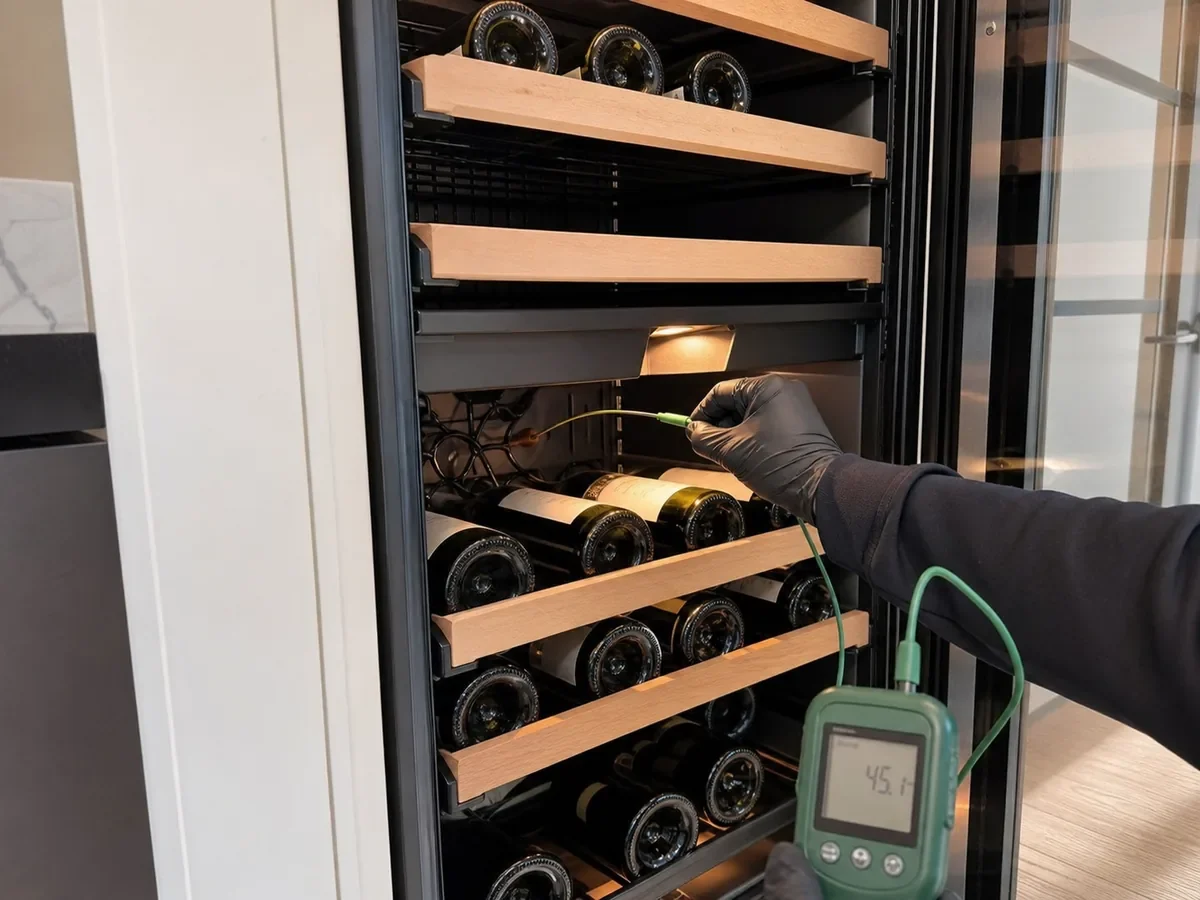
A lot of Moraga and Lamorinda homes treat wine as part of the house, not an afterthought. With the Napa and Sonoma valleys a short drive north and a long tradition of cellaring around Saint Mary's College and the country club, it's common to find a built-in Sub-Zero wine column holding a few hundred bottles in a Campolindo or Sanders Ranch kitchen. So when that column starts reading warm, it isn't a minor annoyance — it's a stored collection slowly cooking, and the clock matters.
Sub-Zero builds genuine wine storage, not a beverage fridge with a label, and the faults that put a column off temperature are specific. Here's what tends to go wrong and how we sort it.
Dual zones, and why one drifts while the other holds
Most built-in Sub-Zero wine units run two independent zones — a cooler reds setting up top, a colder whites or sparkling zone below — each governed by its own thermistor sensor and damper. The classic Moraga call is one zone holding perfectly while the other creeps several degrees off setpoint. That split is the tell: when only one zone drifts, the sealed system is almost always fine and the culprit is a failed sensor reporting the wrong temperature, or a stuck damper that won't open to feed cold air into that compartment. Both are bounded, single-part fixes once we meter the sensor against its resistance curve and watch the damper cycle.
When the whole cabinet goes warm
If both zones rise together, the problem moves upstream to the things that make cold for the entire cabinet. First we check the condenser: in our dry, dusty valley summers the coil loads with grit and oak pollen until it can't shed heat, and a choked coil shows up as a wine cabinet that simply can't pull down on a hot afternoon. Next is airflow — a tired evaporator fan stops circulating the chilled air past the zones. Only after those do we look at the sealed system itself, a refrigerant leak or a weakening compressor, which is the heavier repair and the one where we always put gauge readings in front of you before recommending anything.
The door, the glass, and the things wine hates
Wine storage adds failure points a regular fridge doesn't have. The door carries UV-tinted glass to protect the bottles from light, and its perimeter gasket has to seal a tall, narrow cabinet that gets opened and browsed more than a freezer ever does. A gasket gone stiff or a glass seal that's lost its bead lets warm room air and daylight bleed in, which both warms the cabinet and ages the wine. The other quiet enemy is vibration — a wine column should run smooth, because chronic buzz from a failing fan bearing or a compressor mount disturbs sediment in the bottles and shows up in the glass long before a thermometer flags it. We tend to both when we service a column, not just the temperature reading.
Repair or replace — and when to call
These columns are built to last, so the repair-versus-replace math usually favors repair. A sensor, damper, fan, gasket, or coil clean restores a unit that's otherwise sound, and even a sealed-system repair is often worth it on a built-in matched to a Moraga kitchen's cabinetry. Replacement only really enters the conversation when an older discontinued unit needs a major sealed-system rebuild and a board that's hard to source at once. If your column is reading above 60 degrees on the red zone, sweating on the glass, or humming where it used to be silent, call before the heat does more harm. We run Moraga and the wider Lamorinda valley as a regular route, the $89 diagnostic goes toward the repair, and you can book by phone or online.
Questions & answers
One zone of my Sub-Zero wine cooler is warm but the other is fine — what's wrong?
That split almost always points to a failed temperature sensor or a stuck damper in the drifting zone, not the compressor. When only one zone is off, the sealed system is usually healthy. We meter the sensor and check the damper to confirm which, and both are clean single-part fixes.
Can a warm spell in Moraga actually throw off my wine column?
Yes. A condenser coil loaded with our dry-season dust and pollen can't shed heat well, so the whole cabinet struggles to pull down on a hot day. A coil clean often restores it; if not, we check the evaporator fan and sealed system.
Is it worth repairing an older Sub-Zero wine unit or should I replace it?
Usually repair. Sensors, dampers, fans, gaskets and coil service restore a sound cabinet, and these built-ins are made to run for years. Replacement only really makes sense when an older discontinued unit needs a major sealed-system rebuild — we'll show you the numbers either way.
More Moraga guides
Wolf Range Won't Stop Clicking? Normal Sparks vs. Fault Clicks
Wolf range won't stop clicking? See which clicks are normal, why burners spark after lighting or when off, a 5-step owner check, and when to call a tech.
Read the guide → Choosing a repair service · 5 minThe Over-the-Hill Test: Vetting a Sub-Zero Repair Company in Moraga
Nearly every Sub-Zero specialist serving Moraga drives in from outside town. Four phone-call signals separate a real Lamorinda route from a coverage map.
Read the guide → Odor & air · 4 minWhy Your Sub-Zero Refrigerator Smells: Odor and Air-Purification Fixes in Moraga
A spent air-purification cartridge, a clogged defrost drain, or dried spoiled residue makes a Sub-Zero smell. See how a Moraga tech clears the odor for good.
Read the guide →Rather leave it to a specialist?
Call the published number or book online — keep your model and serial photo and the symptom ready so the visit is planned around the real fault.